Corante: technology, business, media, law, and culture news from the blogosphere
OUR PUBLICATIONS:
Corante is a trusted, unbiased source on technology, business, law, science, and culture that’s authored by leading commentators and thinkers in their respective fields. Corante also produces premium conferences and publications that help decision-makers better understand their industries and the world around them.
Corante Blogs
Corante Blogs examine, through the eyes of leading observers, analysts, thinkers, and doers, critical themes and memes in technology, business, law, science, and culture.
Vin Crosbie, on the challenges, financial and otherwise, that newspaper publishers are facing: "The real problem, Mr. Newspaperman, isn't that your content isn't online or isn't online with multimedia. It's your content. Specifically, it's what you report, which stories you publish, and how you publish them to people, who, by the way, have very different individual interests. The problem is the content you're giving them, stupid; not the platform its on."
by Vin Crosbie in Rebuilding Media
There's a problem in the drug industry that people have recognized for some years, but we're not that much closer to dealing with it than we were then. We keep coming up with these technologies and techniques which seem as if they might be able to help us with some of our nastiest problems - I'm talking about genomics in all its guises, and metabolic profiling, and naturally the various high-throughput screening platforms, and others. But whether these are helping or not (and opinions sure do vary), one thing that they all have in common is that they generate enormous heaps of data.
by Derek Lowe in In the Pipeline
Now that the Web labor market is saturated and Web design a static profession, it's not surprising that 'user experience' designers and researchers who've spent their careers online are looking for new worlds to conquer. Some are returning to the “old media” as directors and producers. More are now doing offline consulting (service experience design, social policy design, exhibition design, and so on) under the 'user experience' aegis. They argue that the lessons they've learned on the Web can be applied to phenomena in the physical and social worlds. But there are enormous differences...
by Bob Jacobson in Total Experience
Clay Shirky, in deconstructing Second Life hype: "Second Life is heading towards two million users. Except it isn’t, really... I suspect Second Life is largely a 'Try Me' virus, where reports of a strange and wonderful new thing draw the masses to log in and try it, but whose ability to retain anything but a fraction of those users is limited. The pattern of a Try Me virus is a rapid spread of first time users, most of whom drop out quickly, with most of the dropouts becoming immune to later use."
by Clay Shirky in Many-to-Many
Over the last few years we've seen old barriers to creativity coming down, one after the other. New technologies and services makes it trivial to publish text, whether by blog or by print-on-demand. Digital photography has democratised a previously expensive hobby. And we're seeing the barriers to movie-making crumble, with affordable high-quality cameras and video hosting provided by YouTube or Google Video and their ilk... Music making has long been easy for anyone to engage in, but technology has made high-quality recording possible without specialised equipment, and the internet has revolutionised distribution, drastically disintermediating the music industry... What's left? Software maybe? Or maybe not."
by Suw Charman in Strange Attractor
Derek Lowe on the news that the Nobel Prize for medicine has gone to Craig Mello and Andrew Fire for their breakthrough work: "RNA interference is probably going to have a long climb before it starts curing many diseases, because many of those problems are even tougher than usual in its case. That doesn't take away from the discovery, though, any more than the complications of off-target effects take away from it when you talk about RNAi's research uses in cell culture. The fact that RNA interference is trickier than it first looked, in vivo or in vitro, is only to be expected. What breakthrough isn't?"
by Derek Lowe in In the Pipeline
Andrew Phelps: "Recently my WoW guild has been having a bit of a debate on the merits of Player-vs.-Player (PvP) within Azeroth. My personal opinion on this is that PvP has its merits, and can be incredible fun, but the system within WoW is horridly, horribly broken. It takes into account the concept of the battle, but battle without consequence, without emotive context, and most importantly, without honor..."
From later in the piece: "When I talk about this with people (thus far anyway) I typically get one of two responses, either 'yeah, right on!' or 'hey, it’s war, and war isn’t honorable – grow the hell up'. There is a lot to be said for that argument – but the problem is that war in the real historical world has very different constraints that are utterly absent from fantasized worlds..."
by Andrew Phelps in Got Game
Derek Lowe: "So, you're developing a drug candidate. You've settled on what looks like a good compound - it has the activity you want in your mouse model of the disease, it's not too hard to make, and it's not toxic. Everything looks fine. Except. . .one slight problem. Although the compound has good blood levels in the mouse and in the dog, in rats it's terrible. For some reason, it just doesn't get up there. Probably some foul metabolic pathway peculiar to rats (whose innards are adapted, after all, for dealing with every kind of garbage that comes along). So, is this a problem?.."
by Derek Lowe in In the Pipeline
Bob Jacobson, on shopping at his local Albertsons supermarket where he had "one of the worst customer experiences" of his life: "Say what you will about the Safeway chain or the Birkenstock billionaires who charge through the roof for Whole Foods' organic fare, they know how to create shopping environments that create a more pleasurable experience, at its best (as at Whole Foods) quite enjoyable. Even the warehouses like Costco and its smaller counterpart, Smart & Final, do just fine: they have no pretentions, but neither do they dump virtual garbage on the consumer merely to create another trivial revenue stream, all for the sake of promotions in the marketing department..."
by Strange Attractor in Total Experience
Kevin Anderson: "First off, I want to say that I really admire the ambition of the Guardian Unlimited’s Comment is Free. It is one of the boldest statements made by any media company that participation needs to be central to a radical revamp of traditional content strategies... It is, therfore, not hugely surprising to find that Comment is Free is having a few teething troubles..."
by Kevin Anderson in strange
Corante Developments
Here you will find the latest news from Corante including updates on upcoming events, new initiatives, product and publication launches, and more.
It was with shock that I returned home from a night out last night to hear the news of Russell's passing. How terribly, terribly sad. Most of all for him, as he'd seemed buoyant, healthier, and content when I'd last seen him several months ago when he was in town - he was happy that work was busy and rewarding and was having fun with it but most of all was thrilled about how things were going with his girlfriend, Ellen.
I've known Russ for what seems like ages now (in a good way) though in fact it's only been about six or seven years since the early days of "commercial" blogging when he started working on various projects at and around Corante. He was a diligent, committed, and prolific journalist who had impressively and more ably than others been able to make the transition from the old-school way of doing things to the new. He had his quirks, as we all do, but I greatly valued that he was good-natured, collegial, reliable, quick to adopt, trustworthy, eager to learn, and earnest in his interest in helping others better understand what he wrote about.
He was also, it should be said, a kind and thoughtful soul and it was the rare conversation in which he didn't ask, with sincerity, about what he knew of my life, e.g. our new babe, and we didn't talk as seemingly old friends about our lives and respective paths. I can't say I knew him very well, of course, but in our half-dozen get-togethers over the years and dozens of conversations I got a good sense of the man: he cared about learning and sharing and his bearing was earnest and ego-less and we'll miss him for that and more.
We wanted to let you know about a discount to New Comm Forum, the annual event event put on by our friends at the Society for New Communications Research. The conference, which runs from April 22-25, will feature many of the field's leading observers and is an important event for those looking, in the words of SNCR, to "better understand new communications tools, technologies and emerging modes of communication, and their effect on traditional media, professional communications, business, culture and society."
Check out the event's website and, if you're interested in attending, be sure to use the code supplied below for a special discount.
EARLY BIRD PRICING - NOW UNTIL FEB. 15th
NewComm Forum Conference - $995.
Pre-conference or post-conference session - $195.
SNCR Jam only - $75.
REGULAR PRICING - AFTER FEB. 15th
NewComm Forum Conference - $1095.
Pre-conference or post-conference session - $249.
SNCR Jam only - $75.
CORANTE READER DISCOUNTS
NewComm Forum Conference - save an additional $100
Use discount code: NCF08100
Pre-conference or post-conference session - save an additional $45.
Use discount code: NCF0845
We've been remiss in letting you know about two new independent blogs we've helped launch in the past month or so.
The first - the ConversationHub - is a companion blog to Supernova 2007, the latest edition of Kevin Werbach's excellent conference on all things connected. As the conference site says: "Supernova examines the effects of an increasingly connected world on business, life, and public policy. As disparate physical and social networks link with one another, a new societal network is rapidly evolving... The New Network is greater than the sum of its parts. It challenges us to re-create everything from the software and hardware we use...to the business models we employ...to the information and entertainment we encounter...to the ways we work and play."
Visit the ConversationHub and you'll find several dozen leading thinkers and doers, led by a few notable ringleaders, weighing in on the themes and trends of the day in technology and business. We encourage you to tune in - feel free to comment and even suggest topics and ideas for posts.
The second blog - Mobile Messaging 2.0 - convenes about a dozen top observers of the mobile messaging space for an intense discussion of the industry and where it's headed. Among its contributors are leading commentators, journalists and players in the field - tune in and you'll find them touching on topics such as mobile device design, messaging platforms, market pressures, user-generated content, interface design, and much, much more.
Also, if you visit the site, which is sponsored by Airwide Solutions, this week, you'll find live coverage and commentary from Global Messaging 2007, to which several of our contributors have traveled to hear about the latest developments from a broad spectrum of the industry's players and providers.
Be sure to catch the Office 2.0 Conference and hear from and engage with leading thinkers and doers in this exciting new market. Find out more here and be sure to use the code "GLDRK" for a special discount for Corante readers.
Don't MissThe AppGap, a blog on the future of the office and small business. Sponsored by QuickBase.
Back in February I discovered the remarkable work of Australian biologist Bryan Grieg Fry, who has been tracing the evolution of venom. As I wrote in the New York Times, he searched the genomes of snakes for venom genes. He discovered that even non-venomous snakes produce venom. By drawing an evolutionary tree of the venom genes, Fry showed that the common ancestor of living snakes had several kinds of venom, which had evolved through accidental "borrowing" of proteins produced in other parts of the body. Later, these genes duplicated to create a sophisticated cocktail of venoms--a cocktail that varied from one lineage of snakes to another.
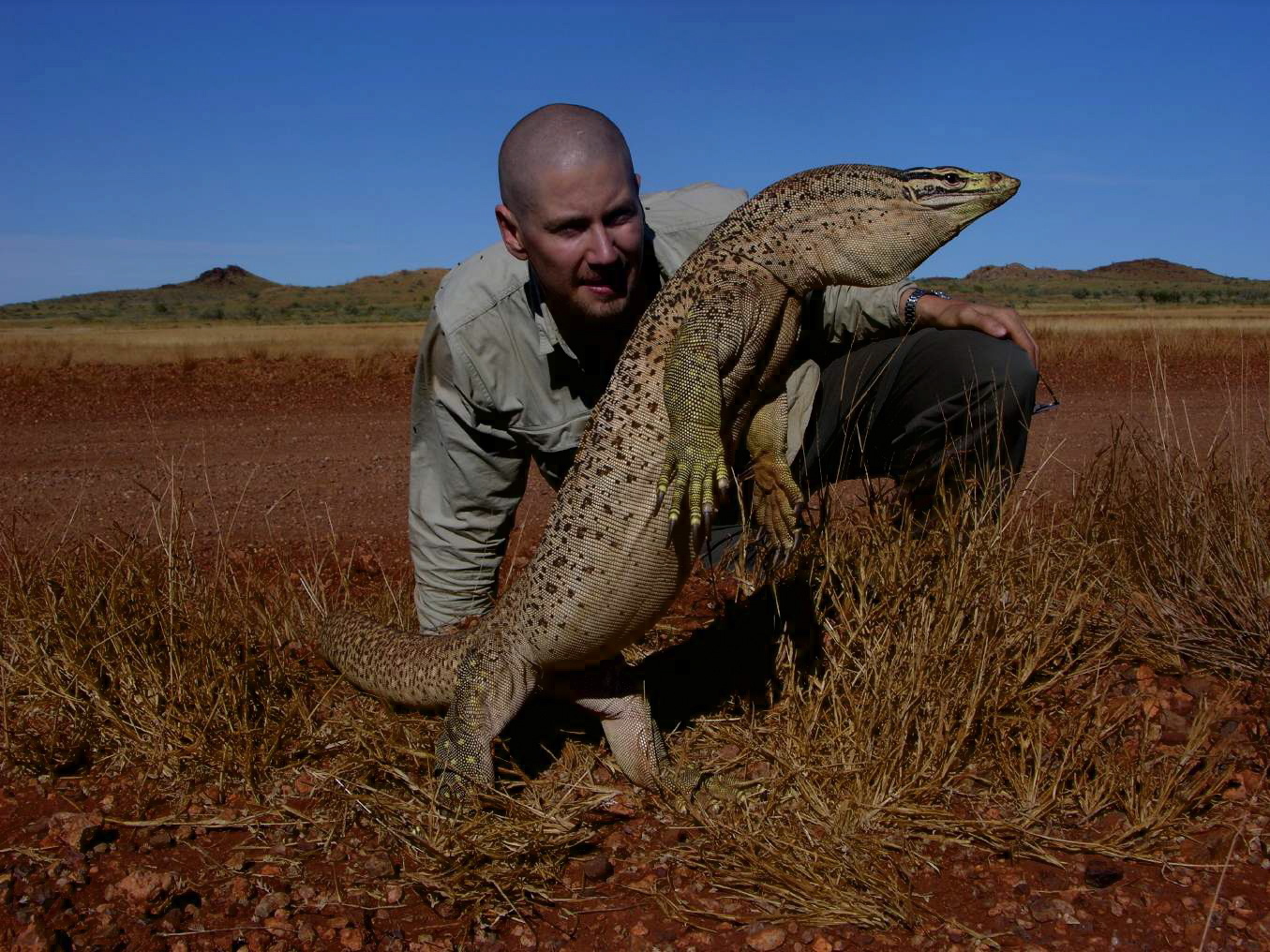
As I report tomorrow in the Times, Fry has taken this research the next logical step. He set out to find out when that ancestral venom evolve. In his search, Fry made an astonishing discovery: snakes are 100 million years old, but snake venom is 200 million years old. This conclusion arose from the fact that some lizards produce the same sorts of venom as snakes--including this desert spotted monitor that Fry is posing next to on one of his venom expeditions in the Outback.
I find that these stories make the most sense if I can map them onto an evolutionary tree. Fortunately this study (published online at Nature) comes with a particularly nice one, which I've reprinted here. It shows how snakes are related to lizards, based on a new large-scale study of DNA. Snakes descend from a close common ancestor with monitor lizards, gila monsters, iguanas, and other related species. They're more distantly related to skinks, gekkos, tuataras, and other less well known lizards.
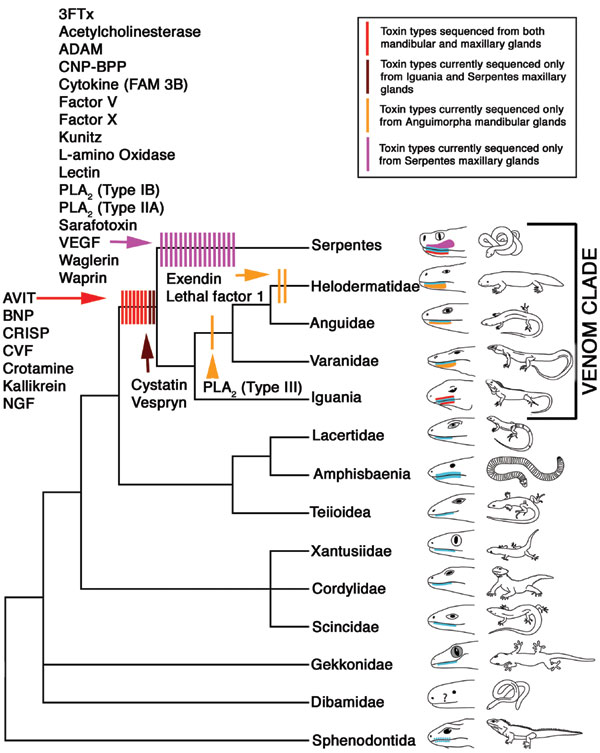
The venomous species did not turn up on random branches of the tree. Instead, they all belong to the same branch, marked on the tree with the name "venom clade." (Clade just means a group of species sharing a common ancestor.) The venoms shared by all of them are marked in red and brown. Red-marked venoms are produced in glands on the top and bottom of the mouth, and brown in the top. Snakes then added on 17 other kinds of venoms. Other lizard clades have venoms of their own, in other marked in yellow. The tree also shows how mouth glands evolved at the same time, beginning as a way to make prey slimey enough to go down the throat to a way to pour venom into a wound.
The story revealed in this tree reveals how a 200-million year old lizard species evolved venom that helped it disable prey long enough to kill them. Over time, new kinds of venom emerged before the common ancestor of living snakes and their close relatives. Snakes later became venom specialists, in some cases evolving a bite that was even fatal to humans and other big animals. At the same time, though, other lizards were acquiring some new venoms of their own, probably as an adaptation to new kinds of prey. It's a process that's going on today, as reflected in different cocktails of venom found in different populations of the same species of lizard.
It will be interesting to see what happens as Fry and others add more branches to this tree. For example, pythons are not known to be venomous. Did they lose venom as they became adept at constrictors? And how did the function of the venoms change with time? A Komodo dragon and a coral snake occupy very different ecological niches, so they need to manipulate their prey in different ways.
Incidentally, I would stress that this discovery does not mean that your pet iguana is going to strike you down tomorrow morning. Lizard venoms are sophisticated, but they typically come in such small doses that they won't cause you any significant harm. And if you do happen to get bit by a Komodo dragon, you'll be able to be distracted from the effects of its venom by the fact that your arm is missing.
First, the animal in the picture isn't a lace monitor (V. varius), but is actually a Sand Monitor / Goana (possibly V. panoptes or gouldi or flaviurus; the taxonomy of this group is utterly insane). Lacies are much prettier, IMHO (google images and see what I mean).
Secondly, they're interesting results, but I'm somewhat uncomfortable with the phylogeny, since if you actually read the footnotes, they only test 5 lizard species and 4 of those were from the same genus, Varanus. The only non-varanid was a lone Iguanian (the super-family, part of family agamidae). As such, it's both too early to write off most of those other branches as not having venom, and too soon to start claiming clades without knowing the extent to which convergence of these protiens has occured over the 3000 odd lizard species (in 20-some-odd families).
Another thing that leapt to mind for me when reading was "so what?", since they don't address the relevance to the ecology/behavior of the species. It's clearly not for prey capture; the lone iguanian eats insects and plants (and just crunches them and gulps them down), and varanids are among the last things needing help dispatching prey (all species analyzed mostly eat small mammals, and they can dispatch those easily; I've personally cleaned rabbit intestines off the *ceiling* of a room-sized cage).
Furthermore, the Komodo strongly indicates against the potency of these chemicals, since, if it had something even approximating useful venom, why didn't it simply enhance that (as Gilas did) to subdue prey rather than evolving a totally distinct, bacteria-based mechanism? The fact that these two took totally separate routes to the same effective end from the same starting points indicates to me that the situation is substantially more complex that it first appears.
Another question I have concerns his previous work as applied to this: if venom protiens are recruited from protiens elsewhere, shouldn't we expect a high degree of convergence, if this recruitment occurs often (which I'd argue that the diversity of snake venoms that have evolved since the Miocene indicates it does)?
Personally, it's neat that he's found these protiens in lizard species, but I think a lot more work needs to be done before forming clades and assessing the role of these protiens in squamate evolution.
Oh and as for constriction vs venom, *usually* they're not found together, but in some species, notably Boiga irregularis (the famous Brown Tree Snake of Guam), both constriction and venom are used, with the former for mammals such as mice and birds, and the latter for skinks and geckos. But this species is only weakly venomous (as I've directly found out), and is what is commonly called "rear-fanged".
Sorry, I just can't resist talking about reptiles.
Is there any further discrimination within the Serpentes clade of how the various kinds of venoms evolved? All those toxins must be more or less monophyletic.
3. Dr. Bryan Fry on November 22, 2005 12:42 AM writes...
G'day Henry,
A couple corrections:
Carl correctly pointed out that that the animal in the picture is a desert spotted monitor (Varanus panoptes rubidus). He didn't say it was a lace monitor.
>evolving a totally distinct, bacteria-based mechanism
Actually that is the entire point. They have venom, not bacteria. The whole bacteria thing has been dogma but a complete red herring. The effects produced by goanna bites (such as rapid swelling, pain and prolonged bleeding, persisting for several hours) are totally inconsistent with bacterial effects. In contrast, we did bioactivity testing of crude varanid venom as well as purified toxin type and demonstrated bioactive effects.
In regards to the glands, the histology has been done previously by one of my co-authors (Elazar Kochva) on all the various lineages. Only the iguanians and anguimorpha of all the lizards have protein secreting glands. The protein secreting glands are not saliva glands, they are newly created structures. There is no homologous gland found elsewhere.
As far as convergence of proteins, convergent selection of the same protein type (e.g. PLA2) would result in toxin clades that are not reciprocally monophyletic in relation to related non-toxin proteins. In contrast, a single shared origin would result in a single toxin clade that is monophyletic in relationship to related non-toxin proteins but not monophyletic for the taxa from which the toxins were sequenced. For more information on this approach, have a read of our 2004 'Assembling an Arsenal' paper published in Molecular Biology and Evolution. In this paper we used this test to show the single origin of venom in snakes. The same methodology was applied here to show the single origin of venom shared between snakes and lizards.
In regards to toxicity of colubrid venoms, pull a couple of our colubrid venom papers from pubmed. Neurotoxic effects of Boiga venom is actually equipotent to highly toxic elapids such as Acanthophis. The key is that the venom yield is smaller and the delivery less efficient. For animals such as Boiga that are feeding mostly on soft-skinned, non-dangerous prey items this is sufficient for them.
We are now investigating the relationships to prey items and actually finding the same sorts of regional variation in venom composition that we have previously with snakes.
Further to Henry's comments above on the phylogeny, it should also be noted that this is based on DNA evidence alone. Phylogeneticists will happily tell you of the common problem that afflicts DNA-based phylogenies in that they often look VERY different to those based on morphological characteristics. This is not to say that either is right or wrong, per se, but snakes are notorious for being very difficult to trace their origins.
Still a fascinating piece of research and worthy of its publication in Nature.
For some reason I'm not getting comments sent to me by email, and so I'm a bit slow these days on the responses. The lace monitor/spotted monitor confusion is my fault--I put lace in the original post, then changed it to the correct name and then realized that I should have used the strikethrough function to show that it had been updated. Arg. Anyway, now it's right. I'll fix the tuatara language too.
Thanks to Bryan for getting into the gorey details.
Just as added interest, Nicolas Vidal and colleagues have a new paper that really shakes up the genealogical tree of reptiles (including snakes). It is in the current issue of C.R. Biologies (easily found on PubMed). Very interesting.
9. David B on November 23, 2005 08:06 AM writes...
Are there any verified cases of mammals with venom? And if not, why not?
I think I've read somewhere that a few shrew species have venomous saliva. And the male platypus has a venomous spike on its feet, used in male-male combat.
Perhaps venom in snakes, insects, etc, has evolved mainly to enable predators to subdue prey larger or more mobile than themselves. Maybe this is seldom the case with mammalian predators. But one might expect e.g. weasels to find venom useful in subduing larger prey such as rabbits.
An alternative possibility is that venom has evolved from salivary enzymes originally used to aid digestion. Mammalian predators tend to tear their prey into chunks, so maybe they did not need strong salivary enzymes.
Fascinating stuff. I'm glad to learn from Dave at No. 5 that the phylogeny's unsettled, otherwise I suppose that, based on the tree up top, we'd really have to stop talking about 'snakes' altogether!
The venomous species did not turn up on random branches of the tree. Instead, they all belong to the same branch, marked on the tree with the name "venom clade." (Clade just means a group of species sharing a common ancestor.)
Wouldn't that be how the tree was designed? Oops, I don't mean THAT designed. Isn't it like saying "all the A's weren't in random sections of the alphabetical list." Aren't animals grouped by common characteristics and naturally would show up in the same branch of the tree? Just a nit pick because I'm a nit picker. :)
Permalink to Comment
David B: "Are there any verified cases of mammals with venom?"
The "slow loris" is a primate which produces a venomlike substance.
"On the inside of their elbows, sebaceous tissue secretes a toxin (like sweat pores, which is rather fitting since the toxic mixture smells remarkably like sweaty socks). The lorises take it into their mouth and deliver it in the bite. "
>Are there any verified cases of mammals with venom? And if not, why not?
Yes, shrews, platypus (the closely related echidna has secondarily lost the venom after it evolved defensive spines) and even a primate group (the lorises). Some of the extinct mammaliforma also had deeply grooved venom delivering teeth.
>Out of curiosity, does the platypus belong to the same "venom clade"?
No, the venom clade in this context is the clade within the squamate reptiles (lizards and snakes) that have venom. Incidently, this clade has now been given the name 'Toxicofera' in Vidal & Hedges' (two of my co-authors on the Nature paper) followup paper to our Nature paper. The followup paper can be downloaded from http://evo.bio.psu.edu/hedgeslab/Publications/PDF-files/171.pdf The platypus is rather unrelated ;-) and represents an independent evolution of venom.
>An alternative possibility is that venom has evolved from salivary enzymes originally used to aid digestion
Proteins in venom are mutated forms of normal body proteins, not salivary proteins. Have a read of my Genome Research paper for more information:
As for Dave's comment, the historical problem has been that trees based upon morphology have relied upon characters that are ambiguous or even were convergently acquired. DNA is infinitely more reliable. DNA is everything, the rest is just details ;-D
In regards to the comment "Fascinating stuff. I'm glad to learn from Dave at No. 5 that the phylogeny's unsettled, otherwise I suppose that, based on the tree up top, we'd really have to stop talking about 'snakes' altogether!" this is not a problem unique to this situation, where historical arrangements have been shown to be artificial once more reliable trees are reconstructed. The Whippo clade is a good example (in case you aren't familiar with this, whales have been shown to be most closely related to hippos). Similarly, reptiles are a concept aren't monophyletic, the birds inconsiderately split the group. So, in reality we need to come up with new names. That is exactly what Vidal & Hedges have done in their excellent paper.
Corante: technology, business, media, law, and culture news from the blogosphere
OUR PUBLICATIONS:
Corante is a trusted, unbiased source on technology, business, law, science, and culture that’s authored by leading commentators and thinkers in their respective fields. Corante also produces premium conferences and publications that help decision-makers better understand their industries and the world around them.
Corante Blogs
Corante Blogs examine, through the eyes of leading observers, analysts, thinkers, and doers, critical themes and memes in technology, business, law, science, and culture.
Vin Crosbie, on the challenges, financial and otherwise, that newspaper publishers are facing: "The real problem, Mr. Newspaperman, isn't that your content isn't online or isn't online with multimedia. It's your content. Specifically, it's what you report, which stories you publish, and how you publish them to people, who, by the way, have very different individual interests. The problem is the content you're giving them, stupid; not the platform its on."
by Vin Crosbie in Rebuilding Media
There's a problem in the drug industry that people have recognized for some years, but we're not that much closer to dealing with it than we were then. We keep coming up with these technologies and techniques which seem as if they might be able to help us with some of our nastiest problems - I'm talking about genomics in all its guises, and metabolic profiling, and naturally the various high-throughput screening platforms, and others. But whether these are helping or not (and opinions sure do vary), one thing that they all have in common is that they generate enormous heaps of data.
by Derek Lowe in In the Pipeline
Now that the Web labor market is saturated and Web design a static profession, it's not surprising that 'user experience' designers and researchers who've spent their careers online are looking for new worlds to conquer. Some are returning to the “old media” as directors and producers. More are now doing offline consulting (service experience design, social policy design, exhibition design, and so on) under the 'user experience' aegis. They argue that the lessons they've learned on the Web can be applied to phenomena in the physical and social worlds. But there are enormous differences...
by Bob Jacobson in Total Experience
Clay Shirky, in deconstructing Second Life hype: "Second Life is heading towards two million users. Except it isn’t, really... I suspect Second Life is largely a 'Try Me' virus, where reports of a strange and wonderful new thing draw the masses to log in and try it, but whose ability to retain anything but a fraction of those users is limited. The pattern of a Try Me virus is a rapid spread of first time users, most of whom drop out quickly, with most of the dropouts becoming immune to later use."
by Clay Shirky in Many-to-Many
Over the last few years we've seen old barriers to creativity coming down, one after the other. New technologies and services makes it trivial to publish text, whether by blog or by print-on-demand. Digital photography has democratised a previously expensive hobby. And we're seeing the barriers to movie-making crumble, with affordable high-quality cameras and video hosting provided by YouTube or Google Video and their ilk... Music making has long been easy for anyone to engage in, but technology has made high-quality recording possible without specialised equipment, and the internet has revolutionised distribution, drastically disintermediating the music industry... What's left? Software maybe? Or maybe not."
by Suw Charman in Strange Attractor
Derek Lowe on the news that the Nobel Prize for medicine has gone to Craig Mello and Andrew Fire for their breakthrough work: "RNA interference is probably going to have a long climb before it starts curing many diseases, because many of those problems are even tougher than usual in its case. That doesn't take away from the discovery, though, any more than the complications of off-target effects take away from it when you talk about RNAi's research uses in cell culture. The fact that RNA interference is trickier than it first looked, in vivo or in vitro, is only to be expected. What breakthrough isn't?"
by Derek Lowe in In the Pipeline
Andrew Phelps: "Recently my WoW guild has been having a bit of a debate on the merits of Player-vs.-Player (PvP) within Azeroth. My personal opinion on this is that PvP has its merits, and can be incredible fun, but the system within WoW is horridly, horribly broken. It takes into account the concept of the battle, but battle without consequence, without emotive context, and most importantly, without honor..."
From later in the piece: "When I talk about this with people (thus far anyway) I typically get one of two responses, either 'yeah, right on!' or 'hey, it’s war, and war isn’t honorable – grow the hell up'. There is a lot to be said for that argument – but the problem is that war in the real historical world has very different constraints that are utterly absent from fantasized worlds..."
by Andrew Phelps in Got Game
Derek Lowe: "So, you're developing a drug candidate. You've settled on what looks like a good compound - it has the activity you want in your mouse model of the disease, it's not too hard to make, and it's not toxic. Everything looks fine. Except. . .one slight problem. Although the compound has good blood levels in the mouse and in the dog, in rats it's terrible. For some reason, it just doesn't get up there. Probably some foul metabolic pathway peculiar to rats (whose innards are adapted, after all, for dealing with every kind of garbage that comes along). So, is this a problem?.."
by Derek Lowe in In the Pipeline
Bob Jacobson, on shopping at his local Albertsons supermarket where he had "one of the worst customer experiences" of his life: "Say what you will about the Safeway chain or the Birkenstock billionaires who charge through the roof for Whole Foods' organic fare, they know how to create shopping environments that create a more pleasurable experience, at its best (as at Whole Foods) quite enjoyable. Even the warehouses like Costco and its smaller counterpart, Smart & Final, do just fine: they have no pretentions, but neither do they dump virtual garbage on the consumer merely to create another trivial revenue stream, all for the sake of promotions in the marketing department..."
by Strange Attractor in Total Experience
Kevin Anderson: "First off, I want to say that I really admire the ambition of the Guardian Unlimited’s Comment is Free. It is one of the boldest statements made by any media company that participation needs to be central to a radical revamp of traditional content strategies... It is, therfore, not hugely surprising to find that Comment is Free is having a few teething troubles..."
by Kevin Anderson in strange
Corante Developments
Here you will find the latest news from Corante including updates on upcoming events, new initiatives, product and publication launches, and more.
It was with shock that I returned home from a night out last night to hear the news of Russell's passing. How terribly, terribly sad. Most of all for him, as he'd seemed buoyant, healthier, and content when I'd last seen him several months ago when he was in town - he was happy that work was busy and rewarding and was having fun with it but most of all was thrilled about how things were going with his girlfriend, Ellen.
I've known Russ for what seems like ages now (in a good way) though in fact it's only been about six or seven years since the early days of "commercial" blogging when he started working on various projects at and around Corante. He was a diligent, committed, and prolific journalist who had impressively and more ably than others been able to make the transition from the old-school way of doing things to the new. He had his quirks, as we all do, but I greatly valued that he was good-natured, collegial, reliable, quick to adopt, trustworthy, eager to learn, and earnest in his interest in helping others better understand what he wrote about.
He was also, it should be said, a kind and thoughtful soul and it was the rare conversation in which he didn't ask, with sincerity, about what he knew of my life, e.g. our new babe, and we didn't talk as seemingly old friends about our lives and respective paths. I can't say I knew him very well, of course, but in our half-dozen get-togethers over the years and dozens of conversations I got a good sense of the man: he cared about learning and sharing and his bearing was earnest and ego-less and we'll miss him for that and more.
We wanted to let you know about a discount to New Comm Forum, the annual event event put on by our friends at the Society for New Communications Research. The conference, which runs from April 22-25, will feature many of the field's leading observers and is an important event for those looking, in the words of SNCR, to "better understand new communications tools, technologies and emerging modes of communication, and their effect on traditional media, professional communications, business, culture and society."
Check out the event's website and, if you're interested in attending, be sure to use the code supplied below for a special discount.
EARLY BIRD PRICING - NOW UNTIL FEB. 15th
NewComm Forum Conference - $995.
Pre-conference or post-conference session - $195.
SNCR Jam only - $75.
REGULAR PRICING - AFTER FEB. 15th
NewComm Forum Conference - $1095.
Pre-conference or post-conference session - $249.
SNCR Jam only - $75.
CORANTE READER DISCOUNTS
NewComm Forum Conference - save an additional $100
Use discount code: NCF08100
Pre-conference or post-conference session - save an additional $45.
Use discount code: NCF0845
We've been remiss in letting you know about two new independent blogs we've helped launch in the past month or so.
The first - the ConversationHub - is a companion blog to Supernova 2007, the latest edition of Kevin Werbach's excellent conference on all things connected. As the conference site says: "Supernova examines the effects of an increasingly connected world on business, life, and public policy. As disparate physical and social networks link with one another, a new societal network is rapidly evolving... The New Network is greater than the sum of its parts. It challenges us to re-create everything from the software and hardware we use...to the business models we employ...to the information and entertainment we encounter...to the ways we work and play."
Visit the ConversationHub and you'll find several dozen leading thinkers and doers, led by a few notable ringleaders, weighing in on the themes and trends of the day in technology and business. We encourage you to tune in - feel free to comment and even suggest topics and ideas for posts.
The second blog - Mobile Messaging 2.0 - convenes about a dozen top observers of the mobile messaging space for an intense discussion of the industry and where it's headed. Among its contributors are leading commentators, journalists and players in the field - tune in and you'll find them touching on topics such as mobile device design, messaging platforms, market pressures, user-generated content, interface design, and much, much more.
Also, if you visit the site, which is sponsored by Airwide Solutions, this week, you'll find live coverage and commentary from Global Messaging 2007, to which several of our contributors have traveled to hear about the latest developments from a broad spectrum of the industry's players and providers.
Be sure to catch the Office 2.0 Conference and hear from and engage with leading thinkers and doers in this exciting new market. Find out more here and be sure to use the code "GLDRK" for a special discount for Corante readers.
1. Henry on November 21, 2005 09:06 PM writes...
A few details here and there on this:
First, the animal in the picture isn't a lace monitor (V. varius), but is actually a Sand Monitor / Goana (possibly V. panoptes or gouldi or flaviurus; the taxonomy of this group is utterly insane). Lacies are much prettier, IMHO (google images and see what I mean).
Secondly, they're interesting results, but I'm somewhat uncomfortable with the phylogeny, since if you actually read the footnotes, they only test 5 lizard species and 4 of those were from the same genus, Varanus. The only non-varanid was a lone Iguanian (the super-family, part of family agamidae). As such, it's both too early to write off most of those other branches as not having venom, and too soon to start claiming clades without knowing the extent to which convergence of these protiens has occured over the 3000 odd lizard species (in 20-some-odd families).
Another thing that leapt to mind for me when reading was "so what?", since they don't address the relevance to the ecology/behavior of the species. It's clearly not for prey capture; the lone iguanian eats insects and plants (and just crunches them and gulps them down), and varanids are among the last things needing help dispatching prey (all species analyzed mostly eat small mammals, and they can dispatch those easily; I've personally cleaned rabbit intestines off the *ceiling* of a room-sized cage).
Furthermore, the Komodo strongly indicates against the potency of these chemicals, since, if it had something even approximating useful venom, why didn't it simply enhance that (as Gilas did) to subdue prey rather than evolving a totally distinct, bacteria-based mechanism? The fact that these two took totally separate routes to the same effective end from the same starting points indicates to me that the situation is substantially more complex that it first appears.
Another question I have concerns his previous work as applied to this: if venom protiens are recruited from protiens elsewhere, shouldn't we expect a high degree of convergence, if this recruitment occurs often (which I'd argue that the diversity of snake venoms that have evolved since the Miocene indicates it does)?
Personally, it's neat that he's found these protiens in lizard species, but I think a lot more work needs to be done before forming clades and assessing the role of these protiens in squamate evolution.
Oh and as for constriction vs venom, *usually* they're not found together, but in some species, notably Boiga irregularis (the famous Brown Tree Snake of Guam), both constriction and venom are used, with the former for mammals such as mice and birds, and the latter for skinks and geckos. But this species is only weakly venomous (as I've directly found out), and is what is commonly called "rear-fanged".
Sorry, I just can't resist talking about reptiles.
Permalink to Comment2. John Wilkins on November 21, 2005 09:59 PM writes...
Is there any further discrimination within the Serpentes clade of how the various kinds of venoms evolved? All those toxins must be more or less monophyletic.
Permalink to Comment3. Dr. Bryan Fry on November 22, 2005 12:42 AM writes...
G'day Henry,
A couple corrections:
Carl correctly pointed out that that the animal in the picture is a desert spotted monitor (Varanus panoptes rubidus). He didn't say it was a lace monitor.
>evolving a totally distinct, bacteria-based mechanism
Actually that is the entire point. They have venom, not bacteria. The whole bacteria thing has been dogma but a complete red herring. The effects produced by goanna bites (such as rapid swelling, pain and prolonged bleeding, persisting for several hours) are totally inconsistent with bacterial effects. In contrast, we did bioactivity testing of crude varanid venom as well as purified toxin type and demonstrated bioactive effects.
In regards to the glands, the histology has been done previously by one of my co-authors (Elazar Kochva) on all the various lineages. Only the iguanians and anguimorpha of all the lizards have protein secreting glands. The protein secreting glands are not saliva glands, they are newly created structures. There is no homologous gland found elsewhere.
As far as convergence of proteins, convergent selection of the same protein type (e.g. PLA2) would result in toxin clades that are not reciprocally monophyletic in relation to related non-toxin proteins. In contrast, a single shared origin would result in a single toxin clade that is monophyletic in relationship to related non-toxin proteins but not monophyletic for the taxa from which the toxins were sequenced. For more information on this approach, have a read of our 2004 'Assembling an Arsenal' paper published in Molecular Biology and Evolution. In this paper we used this test to show the single origin of venom in snakes. The same methodology was applied here to show the single origin of venom shared between snakes and lizards.
In regards to toxicity of colubrid venoms, pull a couple of our colubrid venom papers from pubmed. Neurotoxic effects of Boiga venom is actually equipotent to highly toxic elapids such as Acanthophis. The key is that the venom yield is smaller and the delivery less efficient. For animals such as Boiga that are feeding mostly on soft-skinned, non-dangerous prey items this is sufficient for them.
We are now investigating the relationships to prey items and actually finding the same sorts of regional variation in venom composition that we have previously with snakes.
Cheers
Permalink to CommentBryan
4. coturnix on November 22, 2005 01:11 AM writes...
Just a sidenote - Tuataras are not lizards and are used here as an outgroup.
Permalink to Comment5. Dave on November 22, 2005 07:06 AM writes...
Further to Henry's comments above on the phylogeny, it should also be noted that this is based on DNA evidence alone. Phylogeneticists will happily tell you of the common problem that afflicts DNA-based phylogenies in that they often look VERY different to those based on morphological characteristics. This is not to say that either is right or wrong, per se, but snakes are notorious for being very difficult to trace their origins.
Still a fascinating piece of research and worthy of its publication in Nature.
Permalink to Comment6. RyanJW on November 22, 2005 07:11 AM writes...
Link to the image. http://www.corante.com/loom/img/Fry%20lizard%20tree.jpg
Permalink to Comment7. Carl Zimmer on November 22, 2005 02:16 PM writes...
For some reason I'm not getting comments sent to me by email, and so I'm a bit slow these days on the responses. The lace monitor/spotted monitor confusion is my fault--I put lace in the original post, then changed it to the correct name and then realized that I should have used the strikethrough function to show that it had been updated. Arg. Anyway, now it's right. I'll fix the tuatara language too.
Thanks to Bryan for getting into the gorey details.
For those who want more on the lizard/snake phylogeny, check out this paper by two of the co-authors that's in press. PDF here: http://evo.bio.psu.edu/hedgeslab/Publications/PDF-files/171.pdf
Permalink to Comment8. Cameron Peters on November 22, 2005 10:34 PM writes...
Just as added interest, Nicolas Vidal and colleagues have a new paper that really shakes up the genealogical tree of reptiles (including snakes). It is in the current issue of C.R. Biologies (easily found on PubMed). Very interesting.
Permalink to Comment9. David B on November 23, 2005 08:06 AM writes...
Are there any verified cases of mammals with venom? And if not, why not?
I think I've read somewhere that a few shrew species have venomous saliva. And the male platypus has a venomous spike on its feet, used in male-male combat.
Perhaps venom in snakes, insects, etc, has evolved mainly to enable predators to subdue prey larger or more mobile than themselves. Maybe this is seldom the case with mammalian predators. But one might expect e.g. weasels to find venom useful in subduing larger prey such as rabbits.
An alternative possibility is that venom has evolved from salivary enzymes originally used to aid digestion. Mammalian predators tend to tear their prey into chunks, so maybe they did not need strong salivary enzymes.
This is all just hasty speculation.
Permalink to Comment10. Mrs Tilton on November 23, 2005 04:59 PM writes...
Fascinating stuff. I'm glad to learn from Dave at No. 5 that the phylogeny's unsettled, otherwise I suppose that, based on the tree up top, we'd really have to stop talking about 'snakes' altogether!
Permalink to Comment11. jorzo on November 23, 2005 05:04 PM writes...
Wouldn't that be how the tree was designed? Oops, I don't mean THAT designed. Isn't it like saying "all the A's weren't in random sections of the alphabetical list." Aren't animals grouped by common characteristics and naturally would show up in the same branch of the tree? Just a nit pick because I'm a nit picker. :) Permalink to Comment12. Thanh on November 23, 2005 06:15 PM writes...
Out of curiosity, does the platypus belong to the same "venom clade"?
Permalink to Comment13. Jon H on November 26, 2005 10:31 PM writes...
David B: "Are there any verified cases of mammals with venom?"
The "slow loris" is a primate which produces a venomlike substance.
"On the inside of their elbows, sebaceous tissue secretes a toxin (like sweat pores, which is rather fitting since the toxic mixture smells remarkably like sweaty socks). The lorises take it into their mouth and deliver it in the bite. "
Permalink to Comment14. Dr. Bryan Grieg Fry on November 27, 2005 12:59 AM writes...
>Are there any verified cases of mammals with venom? And if not, why not?
Yes, shrews, platypus (the closely related echidna has secondarily lost the venom after it evolved defensive spines) and even a primate group (the lorises). Some of the extinct mammaliforma also had deeply grooved venom delivering teeth.
>Out of curiosity, does the platypus belong to the same "venom clade"?
No, the venom clade in this context is the clade within the squamate reptiles (lizards and snakes) that have venom. Incidently, this clade has now been given the name 'Toxicofera' in Vidal & Hedges' (two of my co-authors on the Nature paper) followup paper to our Nature paper. The followup paper can be downloaded from http://evo.bio.psu.edu/hedgeslab/Publications/PDF-files/171.pdf The platypus is rather unrelated ;-) and represents an independent evolution of venom.
>An alternative possibility is that venom has evolved from salivary enzymes originally used to aid digestion
Proteins in venom are mutated forms of normal body proteins, not salivary proteins. Have a read of my Genome Research paper for more information:
www.venomdoc.com/downloads/2005_BGF_Genome_2_Venome.pdf
As for Dave's comment, the historical problem has been that trees based upon morphology have relied upon characters that are ambiguous or even were convergently acquired. DNA is infinitely more reliable. DNA is everything, the rest is just details ;-D
In regards to the comment "Fascinating stuff. I'm glad to learn from Dave at No. 5 that the phylogeny's unsettled, otherwise I suppose that, based on the tree up top, we'd really have to stop talking about 'snakes' altogether!" this is not a problem unique to this situation, where historical arrangements have been shown to be artificial once more reliable trees are reconstructed. The Whippo clade is a good example (in case you aren't familiar with this, whales have been shown to be most closely related to hippos). Similarly, reptiles are a concept aren't monophyletic, the birds inconsiderately split the group. So, in reality we need to come up with new names. That is exactly what Vidal & Hedges have done in their excellent paper.
Cheers
Permalink to CommentBryan
15. Jane Shevtsov on December 1, 2005 02:25 AM writes...
Henry was talking about the Komodo dragon, not goannas, having a bacterial prey-killing mechanism.
Permalink to Comment16. Dr. Bryan Fry on December 1, 2005 06:25 PM writes...
>Henry was talking about the Komodo dragon, not goannas, having a bacterial prey-killing mechanism
Goannas and komodos are the same thing, all are monitor lizards. The point is that the bacterial prey-killing story has been a red-herring.
Cheers
Permalink to CommentBryan